
All pull-up variation you should be doing & why
In the hierarchy of bodyweight workout exercises, the pull-up is the undisputed king. It is the ultimate measure of relative strength—the ability to move your own frame through space with power and grace. However, for many, the standard pull-up is a distant goal or a plateau that seems impossible to break.
The secret to mastering this movement lies in pull up variations. By manipulating leverage, grip, and equipment, you can bridge the gap from beginner to advanced athlete, ensuring constant "High-ROI" progress without the need for complex machines.
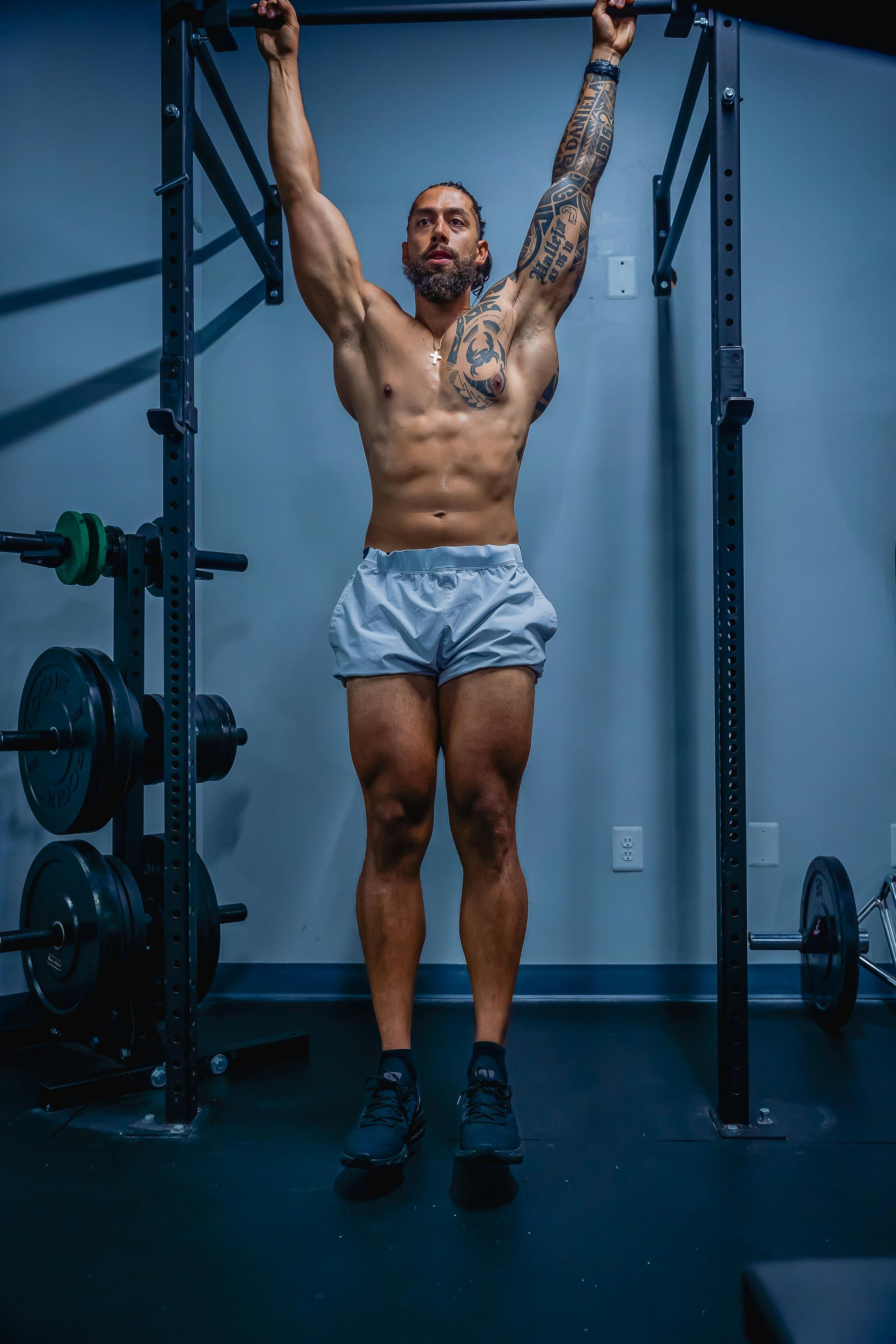
Level 1: The Dead Hang
Before you can pull, you must be able to hold. The dead hang involves simply hanging from a bar with straight arms and a neutral spine, focusing on a firm grip and active shoulders.
Muscles activated & benefits
Primary muscles: Forearms (grip), Trapezius, and Latissimus Dorsi (stabilisation).
Key benefits: This is the foundation of shoulder health. It decompresses the spine, builds the prerequisite grip strength for longer sets, and teaches the "scapular depression" necessary to initiate a powerful pull.
Level 2: The Inverted Row
If you cannot yet pull your full body weight vertically, the inverted row is your primary tool. Using a bar or gymnastic rings, you pull your chest toward the bar while your feet remain on the floor.
Muscles activated & benefits
Primary muscles: Rhomboids, Rear Deltoids, and Mid-Trapezius.
Key benefits: By adjusting the angle of your feet, you can precisely control the resistance. It builds the horizontal pulling strength that balances the shoulders and prevents the "rounded" posture common in busy professionals.
Level 3: Eccentric Pull-Ups
The "negative" phase of a pull-up is where you are strongest. In this variation, you jump or use a box to get your chin over the bar, then lower yourself as slowly as possible (aiming for 5–10 seconds).
Muscles activated & benefits
Primary muscles: Latissimus Dorsi, Biceps Brachii, and Core.
Key benefits: This is the fastest way to achieve your first full rep. Eccentric training creates high levels of mechanical tension, which triggers the neurological adaptations needed to perform a full concentric pull.
Level 4: The Chin-Up
Often the first "full" pull variation beginners master. By using a supinated grip (palms facing you), you place the arms in a mechanically advantageous position.
Muscles activated & benefits
Primary muscles: Biceps Brachii and Lower Lats.
Key benefits: Because of the high bicep recruitment, chin ups are an excellent entry point to the bar. They allow for higher volume training, which is essential for building the initial muscle mass required for more difficult variations.
Level 5: Close Grip Pull-Ups
Using a pronated grip (palms away) with your hands placed inside shoulder width.
Muscles activated & benefits
Primary muscles: Brachialis, Brachioradialis (forearms), and Lower Trapezius.
Key benefits: The narrow grip increases the range of motion at the top of the movement. It is a fantastic variation for building thickness in the mid-back and strengthening the forearms to support heavier loads later.
Level 6: Wide Grip Pull-Ups
Hands are placed significantly wider than shoulder width. This is the classic lat building exercise. If you want that “V” shaped upper body, the wide grip pull-up is an essential tool in your arsenal.
Muscles activated & benefits
Primary muscles: Outer Latissimus Dorsi and Teres Major.
Key benefits: By reducing the involvement of the biceps, the lats are forced to do the heavy lifting. This variation is the key to developing that wide, tapered physique and improving overall pulling strength.

Level 7: The Ring Pull-Up
Taking your training from a fixed bar to gymnastic rings calisthenics introduces the "instability tax." The rings are free to move, requiring constant micro-adjustments. The freedom that the rings provide also allows for a far greater range of motion. This allows you to move your body through numerous pulling motions, activating more muscles and reaping the rewards. Beginning in a traditional pull-up and ending the rep in the chin-up positions is a high ROI exercise.
Muscles activated & benefits
Primary muscles: Deep Core stabilisers, Rotator Cuff, Biceps Brachii, Rhomboids and Lats.
Key benefits: Rings allow for natural joint rotation. As you pull, your wrists can turn from pronated to neutral, significantly reducing the risk of "golfer's elbow." The instability forces the core to fire with every rep, making it a superior functional movement.
Level 8: Weighted Pull-Ups
Once you can perform 12–15 clean bodyweight reps, you have likely reached a hypertrophy plateau. This is where weighted bodyweight training becomes essential.
Muscles activated & benefits
Primary muscles: Entire Pulling Chain (Maximal recruitment).
Key benefits: By adding a weight vest or dipping belt, you move back into the 5–8 rep strength range. This is the definitive method for building superhuman strength and ensuring your back development doesn't stall.
Bonus tip: The False Grip
The false grip is an advanced variation where the wrist is placed directly over the bar or ring rather than hanging below it. It is the definitive tool for those transitioning from raw strength to technical calisthenics mastery.
Muscles activated & benefits
Primary Muscles: Flexor Carpi Ulnaris and Radialis (forearms), Wrist Stabilisers, and Lats.
Key Benefits: This grip significantly increases forearm hypertrophy and grip endurance. By "shortening" the arm, it improves pulling mechanics by keeping the weight closer to your centre of mass. Most importantly, it is the prerequisite for the muscle-up; it keeps the wrist in the "transition" position, allowing you to move from a pull to a push without losing momentum.
Summary: Building a strong stable back with pull-ups
The journey from a dead hang to weighted pull ups is one of the most rewarding paths in functional fitness. By systematically working through these pull up variations, you ensure that your progress is never halted by a plateau. Remember, every variation has its place. Try using the bar for raw power and the rings for joint longevity and stability.
Utilising a variety of pull up variations is the most effective way to develop a strong, stable, and resilient back. By rotating through different grips and planes of movement, you target the smaller stabiliser muscles that are often neglected in traditional weightlifting, ensuring a balanced physique that is as functional as it is aesthetic. This holistic approach to pulling strength not only protects the shoulder girdle from injury but also provides the structural foundation required for high-performance longevity.
Pull-up variation FAQs
-
For most, pulling 2–3 times per week is optimal. Because pull-ups are demanding on the central nervous system and the tendons, rest days are non-negotiable for long-term progress.
-
This is often due to a "fixed" bar trapping your joints. Switching to ring pull ups allows your wrists and elbows to move in their natural path, which usually alleviates this strain.
-
While the wide grip targets the lats effectively, a neutral grip (palms facing each other) is often the strongest and safest for high-volume training and building overall back density.
