
Gymnastic rings calisthenics: The key to bodyweight mastery
In the world of bodyweight training, there is a clear divide between those who train on fixed bars and those who embrace gymnastic rings calisthenics. While pull-up bars and parallel bars are excellent for building a foundation, the rings are where true "superhuman" strength is forged.
If you are serious about calisthenics, gymnastic rings represent the ultimate evolution of your training. They take the standard movements you know: dips, pull-ups, and rows and amplify the difficulty, muscle recruitment, and neurological demand.
Why gymnastic rings are the ultimate calisthenics tool
Traditional calisthenics often relies on static equipment. While effective, fixed bars can limit your progression and occasionally place unnecessary stress on your joints. Transitioning to rings offers three distinct advantages:
1. Freedom of movement
Unlike a straight pull-up bar, rings allow your joints to rotate naturally. This is a game-changer for longevity, especially if you’ve ever experienced "golfer's elbow" from high-volume bar work.
2. The instability factor
In calisthenics, gymnastic rings are famous for the "shake." This instability forces your nervous system to recruit stabiliser muscles that remain dormant on fixed equipment. This leads to a more balanced, "bulletproof" physique.
3. Infinite scalability
One of the primary benefits of gymnastic rings is that they grow with you. By simply adjusting the strap height or your body angle, you can move from absolute beginner to elite-level muscle-ups without ever needing to buy more weight.
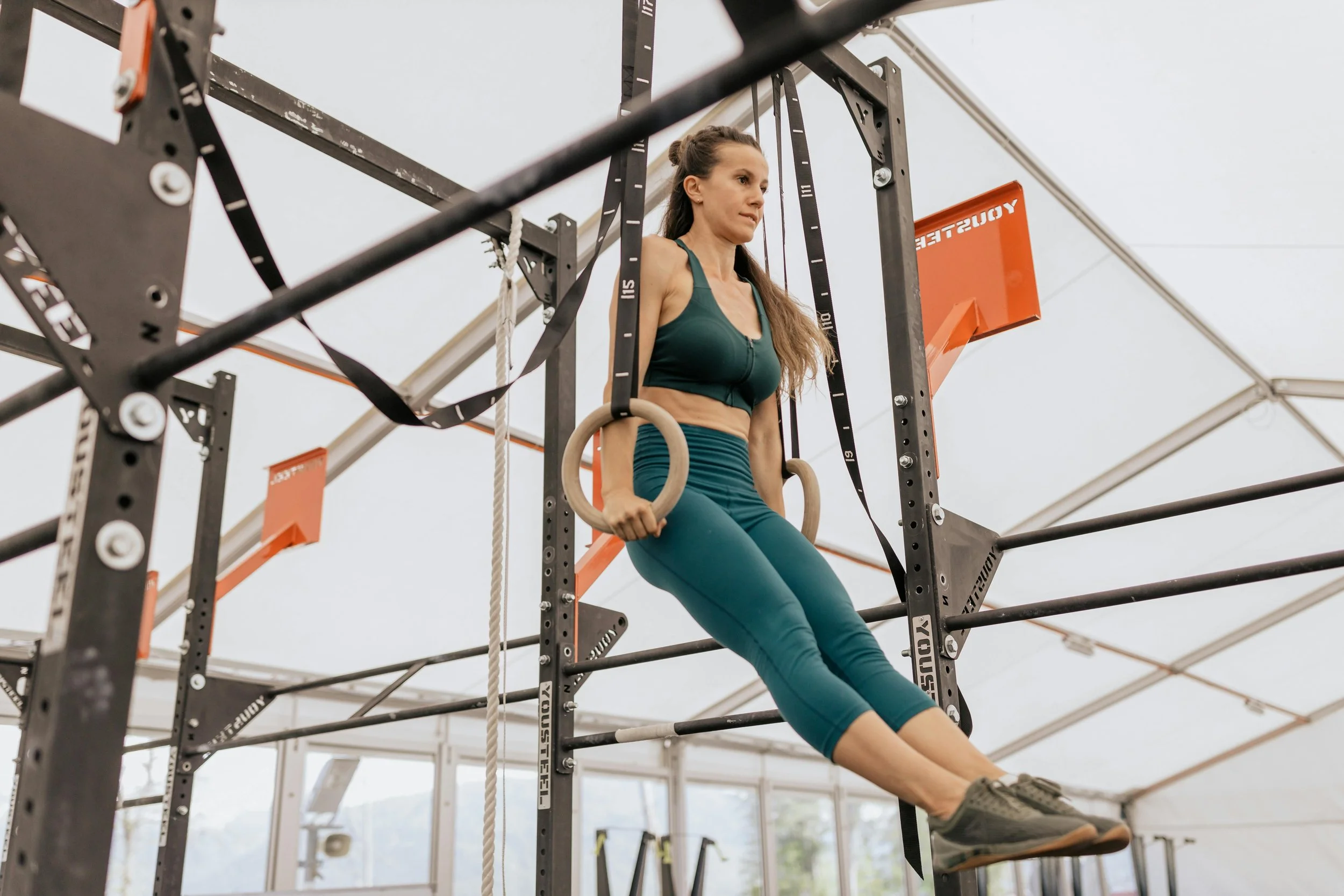
The ring support hold is the key to building a strong and stable foundation.
Breaking physical plateaus: Weighted calisthenics
While the rings themselves provide a significant challenge, there comes a point where bodyweight alone might not be enough to satisfy your hypertrophy and maximal strength goals. This is where weighted gymnastic rings calisthenics comes into play.
Overcoming the bodyweight plateau
Hypertrophy is driven by mechanical tension. By adding a weight vest or a dipping belt with plates/kettlebells, you can apply progressive overload just as you would with a bench press or squat, but with the added "instability tax" of the rings. This combination is arguably the most potent way to build a thick, powerful upper body.
The ultimate home and outdoor freedom
The beauty of weighted calisthenics is that it doesn't require a commercial gym. A pair of rings and a single 24kg kettlebell or a 20kg weight vest can be used in your garden, a local park, or your garage. You retain the freedom of movement and the "anywhere, anytime" ethos of calisthenics while accessing the high-load benefits of traditional weightlifting.
Getting started: From bars to rings
Making the switch to rings requires a shift in mindset. You cannot expect to hit the same rep counts on rings as you do on bars, and that is perfectly normal.
The Foundation: Setup and Support
Before you attempt any advanced skills, your setup must be flawless. Ensure you are hanging your rings from a load-bearing structure and that your straps are even. For a deep dive into the technicalities of height and grip, refer to our complete gymnastics rings guide.
The First Milestone: The Support Hold
The "Support Hold" (holding yourself at the top of a dip with straight arms) is the price of admission for ring training. It builds the prerequisite bicep and shoulder tendon strength needed to avoid injury as you progress to more complex gymnastic ring exercises.
Integrating rings into your calisthenics programme
You don't have to abandon the bars entirely. In fact, many elite athletes use a hybrid approach. However, for maximum upper-body development, we recommend prioritising rings for your "big" movements.
Pulling movements: Switch your bar pull-ups for ring pull-ups to improve grip strength and lat isolation.
Pushing movements: Move your dips to the rings to target the chest and stabilisers more aggressively.
Core work: Use rings for rollouts and L-sits to take your midsection strength to an elite level.
Ready to build your first routine? We’ve mapped out the best gymnastic ring exercises for chest, back, and core to help you structure your sessions for maximum growth.
A steep learning curve
While calisthenics gymnastic rings are arguably the most effective tool for upper-body development, the concession is that they are notoriously "ego-crushing" for those used to high-rep bar work. The transition period can be frustrating as rep counts drop and muscle tremors (shaking) occur.
Furthermore, when introducing weighted calisthenics to the rings, the margin for error narrows significantly; the instability that builds strength can also become a liability if the user lacks the prerequisite tendon density to handle heavy loads on a moving platform. Therefore, while weighted rings offer the highest ROI for strength, they should only be implemented after a solid foundation of bodyweight stability is achieved.
Gymnastic rings calisthenics FAQs
-
Yes, training on gymnastic rings is significantly harder than on fixed bars due to the instability. The rings move in three dimensions, requiring your stabiliser muscles to work constantly to maintain balance. This increased demand typically results in a 20-30% reduction in total reps initially, but leads to greater overall strength gains.
-
Absolutely. Adding weight via a dip belt or weight vest is a fantastic way to increase intensity for dips, pull-ups, and rows. However, ensure you have mastered the bodyweight version with perfect stability first; adding weight to an unstable "shaky" movement significantly increases the risk of injury.
-
While the muscles might feel ready, the connective tissues (tendons and ligaments) in the elbows and shoulders take longer to adapt to ring training. For those new to calisthenics gymnastic rings, we recommend training on them 2-3 times per week, allowing at least 48 hours of recovery between sessions to prevent overuse injuries.
