
The best gymnastic ring exercises for chest, back & core
If you’ve already discovered the incredible versatility and ROI of training with rings, you’re likely ready to move beyond the basics. While traditional calisthenics are effective, gymnastic ring exercises introduce a level of instability that forces your body to adapt, grow, and stabilise in ways that a fixed bar or bench simply cannot replicate.
Mastering these movements requires a blend of patience and precision. Before diving into the specific exercises, ensure your equipment is set up correctly by referring to our comprehensive gymnastics rings guide to avoid common rookie mistakes.
Gymnastic ring exercises for a powerful chest
The "ring dip" and "ring push-up" are legendary for building a thick, functional chest. Because the rings want to fly outward, your pectorals must work overtime just to keep your arms tucked in. These two exercises alone can build a strong, functional upper body. Developing your chest, shoulders and triceps whilst helping maintain and promote healthy joints and ligaments.
1. Ring Push-Ups
Unlike floor push-ups, the rings allow you to descend deeper than the level of your hands, providing a massive stretch and greater muscle fibre recruitment. The instability also activates stabiliser muscles, this additional activation makes ring push-ups far greater for strength gains than normal floor push-ups.
To progress this exercise from beginner to advanced you can gradually elevate your legs. This shifts more of your bodyweight over your hands, as well as activating more of your shoulder and upper pectoral muscles.
The secret: Turn the rings outward (Rings Turned Out or RTO) at the top of the movement to maximise the contraction in your inner chest.
2. Ring Dips
Often called the "squat of the upper body," ring dips are the ultimate chest and tricep builder. The learning curve for this exercise can be a bit difficult at first. For beginners the instability can make your first attempt difficult. In some cases, just holding your bodyweight without losing balance can be a struggle.
To progress the ring dip from beginner to expert you should begin with a simple bodyweight hold. Tense your core, lock out your arms and hold yourself up for as long as you can. Once you’re strong and stable enough to hold your weight on the rings begin with your first few dips.
As you advance you can begin leaning your body forward, tucking your knees close to your body and pushing your bum up in the air. This shifts your centre of gravity and weight over the rings, requiring more strength and activating more of your chest and shoulders, rather than your triceps.
The challenge: Stabilising your body at the top of a dip is significantly harder than on parallel bars. This micro-stability is one of the primary benefits of gymnastic rings for long-term joint health.
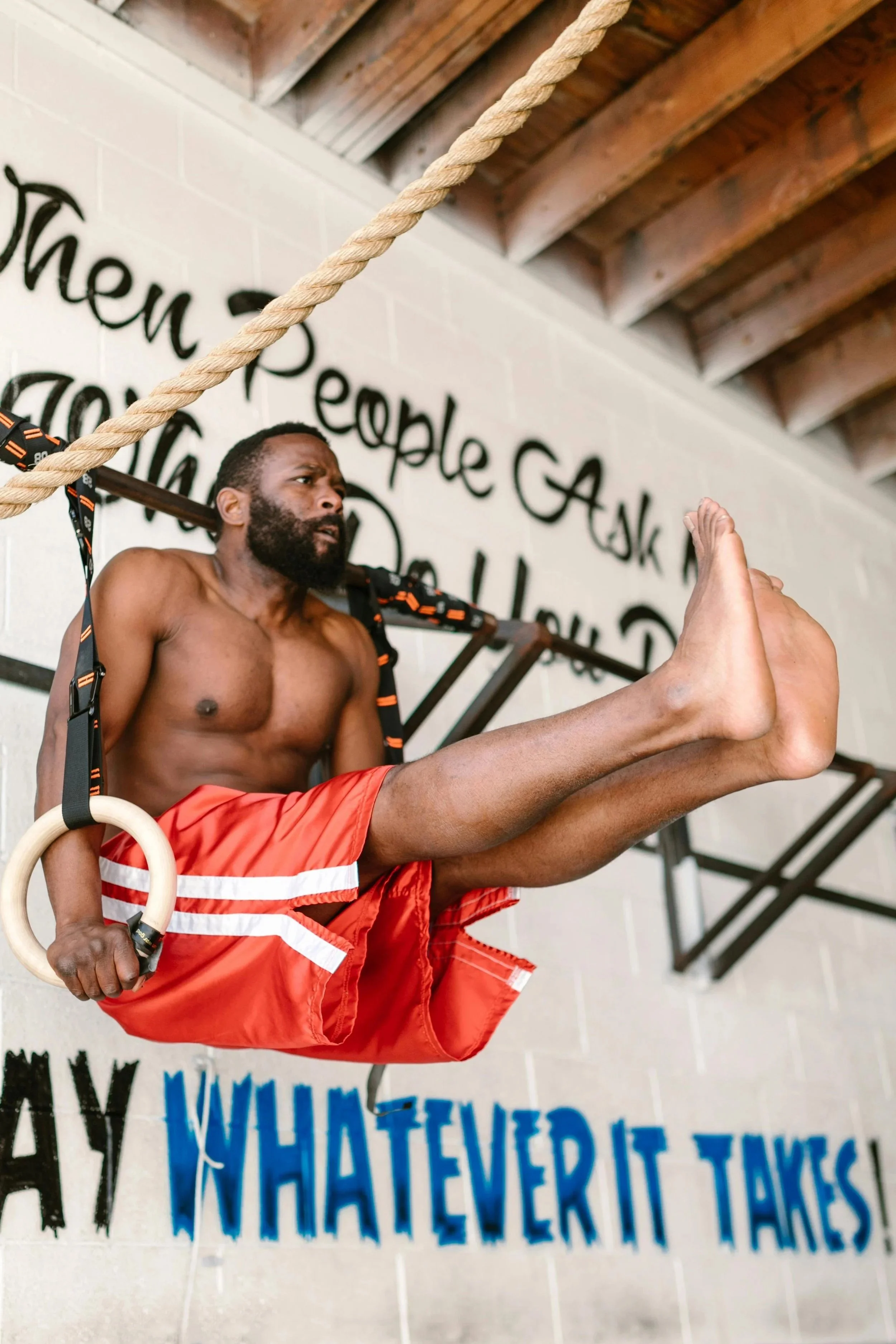
The L-sit is a powerful core exercise that can be done for reps or for extended holds.
Gymnastic ring exercises for a wide, strong back
Because you can rotate your grip freely on rings, you can target the lats and rhomboids from various angles that fixed bars don't allow. Develop the false grip and unlock incredible forearm development and grip strength gains.
1. Ring Rows (Inverted Rows)
The perfect entry point for back development. By adjusting the angle of your body, you can make this exercise as easy or as difficult as needed.
Pro tip: Keep your body in a straight line (hollow body position) and pull the rings to your hips rather than your chest to fully engage the lower lats.
2. Ring Pull-Ups
Rings allow your wrists to rotate naturally from a pronated (palms away) to a neutral or supinated (palms toward you) grip during the pull. This saves your elbows from the repetitive strain often associated with straight-bar pull-ups. In addition to a more natural movement, gymnastic rings also provide a much greater range of motion and muscle activation.
Pro tip: You can activate and train different parts of you back just from changing the position of your back. Training in the hollow or arched back position can help you unlock a stronger, healthier posture as well as greater muscular development.
Gymnastic ring exercises for an “iron” core
Rings are essentially a core trainer in disguise. Even when you are training your chest or back, your midsection is under constant tension. However, these specific moves take core strength to an elite level.
1. The support hold
It looks simple, but holding yourself up on the rings with straight arms and the rings turned out is the foundation of all advanced ring work. It builds incredible "anti-rotational" core strength.
2. Knee/Leg raises
Hanging from the rings adds a layer of difficulty to the standard leg raise. The instability forces your obliques and transverse abdominis to fire constantly to prevent your body from swinging.
3. Ring rollouts
Similar to an ab-wheel rollout, but with the added challenge of controlling two independent moving points. This is arguably the most difficult, and effective, anterior core exercise you can perform.
Summary: Elevate your bodyweight training
Incorporating gymnastic ring exercises into your routine is a commitment to quality over quantity. By focusing on these chest, back, and core movements, you are building a physique that is as capable as it is aesthetic. Remember, the instability is your friend, it is the very thing that drives the results you’re looking for.
Gymnastic ring exercises FAQs
-
For functional strength, core stability, and joint longevity, ring exercises are often superior. While weights are better for maximal "absolute" strength (like a heavy bench press), rings build "relative" strength and a level of body control that is difficult to achieve with external loading.
-
Shaking (muscle tremors) is common for beginners. This is your nervous system learning to fire your stabiliser muscles. The best way to stop the shaking is through "Support Hold" practice, simply spending time at the top of the rings with straight arms to build neurological familiarity.
-
Absolutely. Every ring exercise can be "scaled." For example, if you can't do a pull-up, you can perform ring rows with your feet on the floor. The adjustable height of the straps makes rings one of the most beginner-friendly tools in the gym.
